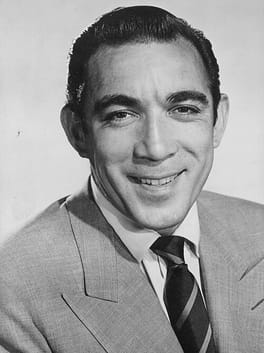
Photo: Unknown author / Public domain (source: Wikimedia Commons)
Anthony Quinn was a film actor, sculptor and writer, born on April 21, 1915 in Chihuahua City, Chihuahua, Mexico. Anthony Quinn died on June 3, 2001 at the age of 86. Schooling on record includes Belmont High School. Listed accolades include Donostia Award (1995), Academy Award for Best Supporting Actor (1953, 1957), star on Hollywood Walk of Fame and 1 more.
My Take
What I admire most about Anthony Quinn is how completely he refused to be boxed in. A boy born in Chihuahua became one of Hollywood's most magnetic presences, then turned around and lived equally seriously as a sculptor and a writer. Two Best Supporting Actor wins barely capture it; across a hundred-plus roles he radiated this earthy, untamed vitality that you simply cannot teach. To me he stands as proof that an outsider can dominate an industry through sheer force of being, no apology required. I find his whole eighty-six-year arc more cinematic than most of the films he was actually in.
This take was written by generative AI, one per person, from publicly reported facts (editorial policy). It is a reading of the record, not reporting.
1. Profile
- Name (English)
- Anthony Quinn
- Name (Japanese)
- アンソニー・クイン
- Reading
- あんそにー・くいん
- Born
- April 21, 1915 – June 3, 2001
- Origin
- Chihuahua City, Chihuahua, Mexico
- Occupation
- film actor / sculptor / writer / film director / actor
- Zodiac / Chinese zodiac
- Taurus / Rabbit
2. Background
- High school
- Belmont High School
Awards & achievements
- 1995 Donostia Award
- 1953 Academy Award for Best Supporting Actor
- 1957 Academy Award for Best Supporting Actor
- star on Hollywood Walk of Fame
- Golden Globe Cecil B. DeMille Award
3. Links
- Official sitehttps://www.anthonyquinn.com
- Wikipedia (English)https://en.wikipedia.org/wiki/Anthony%20Quinn
- Wikipedia (Japanese)https://ja.wikipedia.org/wiki/%E3%82%A2%E3%83%B3%E3%82%BD%E3%83%8B%E3%83%BC%E3%83%BB%E3%82%AF%E3%82%A4%E3%83%B3
- Wikidatahttps://www.wikidata.org/wiki/Q83484
4. About this entry
Tags
- Last updated
Facts are limited to publicly available information up to 2024; non-public or unconfirmed items are omitted. English text is machine-assisted (facts translated by Sonnet, "My Take" written by Opus 4.8). The Japanese page is the source of record.
Frequently asked questions
When was Anthony Quinn born?
Anthony Quinn was born on April 21, 1915.
When did Anthony Quinn die?
Anthony Quinn died on June 3, 2001, aged 86.
Where was Anthony Quinn from?
Anthony Quinn was from Chihuahua City, Chihuahua, Mexico.
What did Anthony Quinn do?
Anthony Quinn worked as film actor, sculptor, writer, film director, actor.
Which high school did Anthony Quinn attend?
Anthony Quinn attended Belmont High School.
Film actor — see all → · Sculptor — see all → · More people from Mexico → · More people born on April 21 →