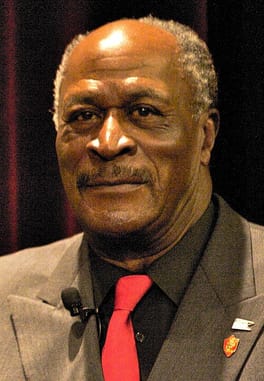
Photo: U.S. National Archives / Public domain (source: Wikimedia Commons)
John Amos was born on December 27, 1939 in Newark, New Jersey, United States. John Amos was credited as a television actor, film actor and stage actor. Death is recorded on August 21, 2024, at the age of 84. Education on record includes East Orange High School and Long Beach City College. Awards on record include New Jersey Hall of Fame (2019).
My Take
John Amos was the kind of actor who made you feel the weight of a scene just by walking into it. I grew up knowing him as James Evans Sr. on Good Times — that warm, stubborn, fiercely loving father who became a touchstone for so many Black families on American television — but the moment he showed up as adult Kunta Kinte in Roots, you realized this man had a whole other gear. That miniseries was a cultural earthquake, and Amos was at the center of it, carrying generations of pain and defiance with complete conviction. Then he'd pop up in Die Hard 2 as a tough, no-nonsense military man and remind you he could do anything. He came from Newark, built a career the hard way, and earned his New Jersey Hall of Fame induction in 2019 the old-fashioned way — by outlasting the doubters. Gone in August 2024 at 84, and genuinely irreplaceable.
This take was written by generative AI, one per person, from publicly reported facts (editorial policy). It is a reading of the record, not reporting.
1. Profile
- Name (English)
- John Amos
- Name (Japanese)
- ジョン・エイモス
- Reading
- じょん・えいもす
- Born
- December 27, 1939 – August 21, 2024
- Origin
- Newark, New Jersey, United States
- Occupation
- television actor / film actor / stage actor / filmmaker / film producer
- Zodiac / Chinese zodiac
- Capricorn / Rabbit
2. Background
- High school
- East Orange High School
- University
- Long Beach City College
Awards & achievements
- 2019 New Jersey Hall of Fame
3. Works & records
Filmography / notable works
| Category | Title |
|---|---|
| Notable work | The Last Rifleman |
4. Links
- Wikipedia (English)https://en.wikipedia.org/wiki/John%20Amos
- Wikipedia (Japanese)https://ja.wikipedia.org/wiki/%E3%82%B8%E3%83%A7%E3%83%B3%E3%83%BB%E3%82%A8%E3%82%A4%E3%83%A2%E3%82%B9
- Wikidatahttps://www.wikidata.org/wiki/Q498820
5. About this entry
Tags
- Last updated
Only publicly available facts are listed; non-public or unconfirmed items are omitted. Base data was compiled from Wikidata from June 2026 onward; ages are recalculated daily and deaths are checked against Wikidata on an ongoing basis. English text is machine-assisted (facts translated by Sonnet, "My Take" written by Opus 4.8). The Japanese page is the source of record.
Frequently asked questions
When was John Amos born?
John Amos was born on December 27, 1939.
When did John Amos die?
John Amos died on August 21, 2024, aged 84.
Where was John Amos from?
John Amos was from Newark, New Jersey, United States.
What did John Amos do?
John Amos worked as television actor, film actor, stage actor, filmmaker, film producer.
Where did John Amos study?
John Amos attended Long Beach City College.
What was John Amos known for?
John Amos's notable works include The Last Rifleman.
Television actor — see all → · Film actor — see all → · More people from the United States → · More people born on December 27 →