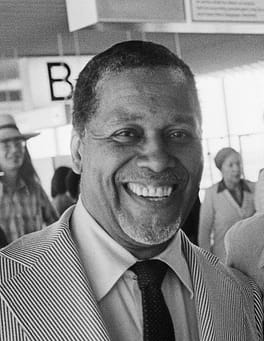
Photo: Bert Verhoeff for Anefo / CC BY-SA 3.0 nl (source: Wikimedia Commons)
My Take
John Lewis brought a chamber-music elegance to jazz that nobody else quite matched. As the brain behind the Modern Jazz Quartet, he proved you could pair bebop's freedom with the rigor of counterpoint and fugue, and somehow make it swing rather than stiffen. His touch at the piano was famously spare, every note doing real work, which I find more daring than a flurry of them. He also took jazz seriously as scholarship, teaching and championing the music as art. Refined without ever being bloodless, his legacy is proof that restraint can be its own kind of virtuosity.
This take was written by generative AI, one per person, from publicly reported facts (editorial policy). It is a reading of the record, not reporting.
Overview
John Lewis was an American jazz pianist, composer, and music educator born May 3, 1920, in La Grange, Illinois, and died March 29, 2001. He studied at the University of New Mexico and became the musical director of the Modern Jazz Quartet, the influential ensemble he led for decades. Known for blending classical structure with jazz, he received the NEA Jazz Masters honor and was a respected teacher.
1. Profile
- Name (English)
- John Lewis
- Name (Japanese)
- ジョン・ルイス
- Reading
- じょん・るいす
- Born
- May 3, 1920 – March 29, 2001
- Origin
- La Grange, Illinois, United States
- Occupation
- Pianist / Composer / Music educator / Jazz musician / University faculty
- Zodiac / Chinese zodiac
- Taurus / Monkey
2. Background
- University
- University of New Mexico
Awards & achievements
- NEA Jazz Masters Award
3. Links
4. About this entry
Tags
- Last updated
Facts are limited to publicly available information up to 2024; non-public or unconfirmed items are omitted. English text is machine-assisted (facts translated by Sonnet, "My Take" written by Opus 4.8). The Japanese page is the source of record.
Frequently asked questions
When was John Lewis born?
Born May 3, 1920.
When did John Lewis die?
Died March 29, 2001, aged 80.
Where was John Lewis from?
John Lewis was from La Grange, Illinois, United States.
What did John Lewis do?
John Lewis worked as Pianist, Composer, Music educator, Jazz musician, University faculty.
Pianist — see all → · Composer — see all → · More people from the United States →