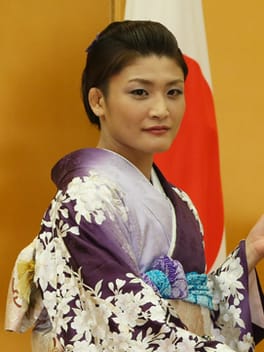
Photo: 首相官邸 / CC BY 4.0 (source: Wikimedia Commons)
My Take
I'll be honest, Kaori Icho is one of those athletes whose record sounds made up — four straight Olympic golds, the first woman in any sport to pull that off in an individual event — and yet every photo of her radiates this quiet, almost shy calm. That contrast gets me. She came up out of Hachinohe in snowy Aomori, trained at Shigakukan, and just kept winning across more than a decade on the mat without ever turning into a loud personality about it. I love that she earned the People's Honour Award and still seems like the last person who'd brag. There's an old line about the strongest people being the quietest, and she's basically the human version of it. As someone who put Japanese women's wrestling on the world map, she has my flat-out respect.
This take was written by generative AI, one per person, from publicly reported facts (editorial policy). It is a reading of the record, not reporting.
Overview
Kaori Icho is a Japanese amateur wrestler born on June 13, 1984, in Hachinohe, Aomori Prefecture. She graduated from Shigakukan University and built one of the most decorated careers in Japanese wrestling history. She received the Order of the Purple Ribbon in 2004, the Kikuchi Kan Prize in 2012, and the People's Honor Award in 2016, making her one of a select few athletes to receive Japan's highest civic honor.
1. Profile
- Name (English)
- Kaori Icho
- Name (Japanese)
- 伊調馨
- Reading
- いちょう かおり
- Born
- June 13, 1984 (age 42)
- Origin
- Hachinohe, Aomori Prefecture, Japan
- Height
- 166 cm
- Occupation
- Amateur wrestler
- Zodiac / Chinese zodiac
- Gemini / Rat
2. Background
- University
- Shigakukan University
Awards & achievements
- 2004 — Order of the Purple Ribbon
- 2012 — Kikuchi Kan Prize
- 2016 — People's Honor Award
3. Links
- Wikipedia (Japanese)https://ja.wikipedia.org/wiki/%E4%BC%8A%E8%AA%BF%E9%A6%A8
- Wikidatahttps://www.wikidata.org/wiki/Q233460
4. About this entry
Tags
- Last updated
Only publicly available facts are listed; non-public or unconfirmed items are omitted. Base data was compiled from Wikidata from June 2026 onward; ages are recalculated daily and deaths are checked against Wikidata on an ongoing basis. English text is machine-assisted (facts translated by Sonnet, "My Take" written by Opus 4.8). The Japanese page is the source of record.
Frequently asked questions
When was Kaori Icho born?
Kaori Icho was born on June 13, 1984 and is 42 years old.
Where is Kaori Icho from?
Kaori Icho is from Hachinohe, Aomori Prefecture, Japan.
What does Kaori Icho do?
Kaori Icho works as Amateur wrestler.
How tall is Kaori Icho?
Kaori Icho is 166 cm tall.
Where did Kaori Icho study?
Kaori Icho attended Shigakukan University.
Amateur wrestler — see all → · More people from Japan → · More people born on June 13 →