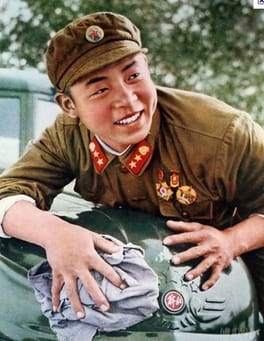
Photo: Unknown author / Public domain (source: Wikimedia Commons)
Lei Feng was a military personnel and soldier. Born on December 18, 1940, Lei Feng was from Wangcheng District, People's Republic of China. Death is recorded on August 15, 1962, at the age of 21.
My Take
Lei Feng is impossible to assess as a simple person; he is a symbol. Dead at 21 in 1962, then transformed into a national model citizen through the 1963 campaign urging people to follow his example. I am wary of how thoroughly his memory was instrumentalized for propaganda, and that wariness matters. Yet the virtues attached to his name, selflessness, modesty, devotion, are genuinely universal, transcending the politics that amplified them. What fascinates me is how a short, ordinary life became a mirror for an entire society's aspirations. I withhold judgment on the myth, but I respect the weight the name still carries.
This take was written by generative AI, one per person, from publicly reported facts (editorial policy). It is a reading of the record, not reporting.
1. Profile
- Name (English)
- Lei Feng
- Name (Japanese)
- 雷鋒
- Reading
- らい ほう
- Born
- December 18, 1940 – August 15, 1962
- Origin
- Wangcheng District, People's Republic of China
- Occupation
- military personnel / soldier
- Zodiac / Chinese zodiac
- Sagittarius / Dragon
2. Links
- Wikipedia (English)https://en.wikipedia.org/wiki/Lei%20Feng
- Wikipedia (Japanese)https://ja.wikipedia.org/wiki/%E9%9B%B7%E9%8B%92
- Wikidatahttps://www.wikidata.org/wiki/Q379835
3. About this entry
Tags
- Last updated
Facts are limited to publicly available information up to 2024; non-public or unconfirmed items are omitted. English text is machine-assisted (facts translated by Sonnet, "My Take" written by Opus 4.8). The Japanese page is the source of record.
Frequently asked questions
When was Lei Feng born?
Lei Feng was born on December 18, 1940.
When did Lei Feng die?
Lei Feng died on August 15, 1962, aged 21.
Where was Lei Feng from?
Lei Feng was from Wangcheng District, People's Republic of China.
What did Lei Feng do?
Lei Feng worked as military personnel, soldier.
Military personnel — see all → · Soldier — see all → · More people from the People's Republic of China → · More people born on December 18 →