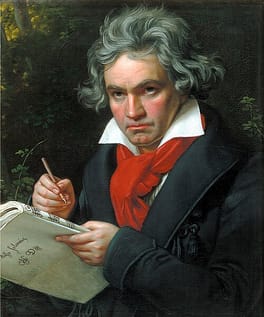
Photo: Joseph Karl Stieler / Public domain (source: Wikimedia Commons)
Ludwig van Beethoven was born in Bonn, North Rhine-Westphalia, Germany on December 16, 1770. Ludwig van Beethoven was listed as a composer, pianist and conductor. Death is recorded on March 26, 1827, at the age of 56. Listed accolades include Bröckemännche Award (2020). Credited works include Für Elise, Symphony No. 9 and Piano Sonata No. 14.
My Take
What gets me every time with Beethoven is the sheer stubbornness of the man — going deaf and still producing the Ninth Symphony, arguably the most emotionally overwhelming piece of orchestral music ever written, without hearing a single note of it performed. He bridged the Classical and Romantic eras almost single-handedly, taking the neat, structured world Haydn and Mozart built and cracking it wide open with raw emotional intensity. The opening four notes of the Fifth Symphony are probably the most recognized musical phrase on the planet for a reason. And then there's the Moonlight Sonata — something he dashed off as one of many piano sonatas — that still stops people cold two centuries later. Born in Bonn in 1770, gone by 1827, and yet the catalog he left behind feels inexhaustible. Honestly, the more you dig in, the more you realize just how far ahead of his time he really was.
This take was written by generative AI, one per person, from publicly reported facts (editorial policy). It is a reading of the record, not reporting.
1. Profile
- Name (English)
- Ludwig van Beethoven
- Name (Japanese)
- ルートヴィヒ・ヴァン・ベートーヴェン
- Reading
- るーとゔぃひ・ゔぁん・べーとーゔぇん
- Born
- December 16, 1770 – March 26, 1827
- Origin
- Bonn, North Rhine-Westphalia, Germany
- Occupation
- composer / pianist / conductor / music educator / organist
- Zodiac / Chinese zodiac
- Sagittarius / Tiger
2. Background
Awards & achievements
- 2020 Bröckemännche Award
3. Works & records
Filmography / notable works
| Category | Title |
|---|---|
| Notable work | Für Elise |
| Notable work | Symphony No. 9 |
| Notable work | Piano Sonata No. 14 |
| Notable work | Missa Solemnis |
| Notable work | Piano Sonata No. 8 |
| Notable work | Symphony No. 5 |
4. Links
- Official sitehttps://beethoven.de
- Wikipedia (English)https://en.wikipedia.org/wiki/Ludwig%20van%20Beethoven
- Wikipedia (Japanese)https://ja.wikipedia.org/wiki/%E3%83%AB%E3%83%BC%E3%83%88%E3%83%B4%E3%82%A3%E3%83%92%E3%83%BB%E3%83%B4%E3%82%A1%E3%83%B3%E3%83%BB%E3%83%99%E3%83%BC%E3%83%88%E3%83%BC%E3%83%B4%E3%82%A7%E3%83%B3
- Wikidatahttps://www.wikidata.org/wiki/Q255
5. About this entry
Tags
- Last updated
Facts are limited to publicly available information up to 2024; non-public or unconfirmed items are omitted. English text is machine-assisted (facts translated by Sonnet, "My Take" written by Opus 4.8). The Japanese page is the source of record.
Frequently asked questions
When was Ludwig van Beethoven born?
Born December 16, 1770.
When did Ludwig van Beethoven die?
Died March 26, 1827, aged 56.
Where was Ludwig van Beethoven from?
Ludwig van Beethoven was from Bonn, North Rhine-Westphalia, Germany.
What did Ludwig van Beethoven do?
Ludwig van Beethoven worked as composer, pianist, conductor, music educator, organist.
What was Ludwig van Beethoven known for?
Notable works include Für Elise, Symphony No. 9, Piano Sonata No. 14.
Composer — see all → · Pianist — see all → · More people from Germany →