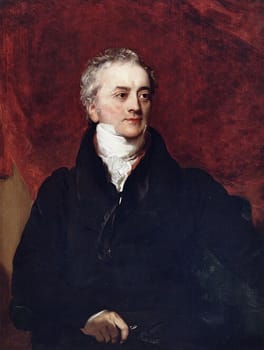
Photo: Henry Perronet Briggs / Public domain (source: Wikimedia Commons)
Born on June 13, 1773 in Milverton, United Kingdom, Thomas Young was an astronomer, physicist and anthropologist. Death is recorded on May 10, 1829, at the age of 55. Education on record includes University of Edinburgh. Listed accolades include Fellow of the Royal Society (1794), Croonian Medal and Lecture (1808), Royal Society Bakerian Medal (1803) and 1 more. Credited works include double-slit experiment, Wave theory of light and astigmatism.
My Take
Thomas Young is, in my view, one of history's most underrated geniuses. The double-slit experiment alone reshaped how we understand light, but the man also probed vision, astigmatism, color perception, and even helped crack Egyptian hieroglyphs on the Rosetta Stone. That range borders on absurd. What fascinates me is that he refused to specialize in an age increasingly demanding it, and his fingerprints still appear in the work of Helmholtz, Maxwell, and Einstein. I respect specialists, but Young reminds me how powerful relentless curiosity across fields can be. He is my favorite kind of polymath: quietly enormous in influence.
This take was written by generative AI, one per person, from publicly reported facts (editorial policy). It is a reading of the record, not reporting.
1. Profile
- Name (English)
- Thomas Young
- Name (Japanese)
- トマス・ヤング
- Reading
- とます・やんぐ
- Born
- June 13, 1773 – May 10, 1829
- Origin
- Milverton, United Kingdom
- Occupation
- astronomer / physicist / anthropologist / physician / archaeologist
- Zodiac / Chinese zodiac
- Gemini / Snake
2. Background
- University
- University of Edinburgh
Awards & achievements
- 1794 Fellow of the Royal Society
- 1808 Croonian Medal and Lecture
- 1803 Royal Society Bakerian Medal
- 1822 Fellow of the American Academy of Arts and Sciences
3. Works & records
Filmography / notable works
| Category | Title |
|---|---|
| Notable work | double-slit experiment |
| Notable work | Wave theory of light |
| Notable work | astigmatism |
| Notable work | Young–Dupré Equation |
| Notable work | Young–Helmholtz theory |
| Notable work | Young–Laplace equation |
4. Links
- Wikipedia (English)https://en.wikipedia.org/wiki/Thomas%20Young%20(scientist)
- Wikipedia (Japanese)https://ja.wikipedia.org/wiki/%E3%83%88%E3%83%9E%E3%82%B9%E3%83%BB%E3%83%A4%E3%83%B3%E3%82%B0
- Wikidatahttps://www.wikidata.org/wiki/Q25820
5. About this entry
Tags
- Last updated
Facts are limited to publicly available information up to 2024; non-public or unconfirmed items are omitted. English text is machine-assisted (facts translated by Sonnet, "My Take" written by Opus 4.8). The Japanese page is the source of record.
Frequently asked questions
When was Thomas Young born?
Thomas Young was born on June 13, 1773.
When did Thomas Young die?
Thomas Young died on May 10, 1829, aged 55.
Where was Thomas Young from?
Thomas Young was from Milverton, United Kingdom.
What did Thomas Young do?
Thomas Young worked as astronomer, physicist, anthropologist, physician, archaeologist.
Where did Thomas Young study?
Thomas Young attended University of Edinburgh.
What was Thomas Young known for?
Thomas Young's notable works include double-slit experiment, Wave theory of light, astigmatism.
Astronomer — see all → · Physicist — see all → · More people from the United Kingdom → · More people born on June 13 →