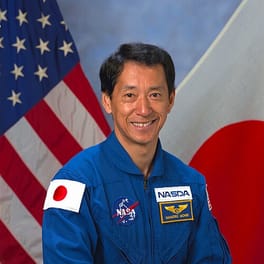
Photo: NASA / Public domain (source: Wikimedia Commons)
My Take
Okay, can we talk about how this one guy was an astronaut AND a chemist AND a university professor, because I'm exhausted just typing that. Mamoru Mohri grew up in Yoichi, Hokkaido, a little coastal town hugged by sea and mountains, and somehow that kid ended up strapped into the Space Shuttle looking down at the whole blue planet. That's a fairy tale that actually came true, and it gets me every time. He's the rare brainy type who can talk about orbital science without making your eyes glaze over, and honestly that's the mark of someone who really knows their stuff. I love that quietly thrilled energy he has, feet planted in hard data while his head's pointed straight at the stars. A genuine dreamer with a lab coat. What a life.
This take was written by generative AI, one per person, from publicly reported facts (editorial policy). It is a reading of the record, not reporting.
Overview
Mamoru Mohri is a Japanese former astronaut, chemist, and university educator born on January 29, 1948, in Yoichi, Hokkaido, Japan. He completed his higher education at Flinders University. In 2018 he was awarded the Chevalier of the Legion of Honour. He is recognized as one of Japan's pioneering figures in human spaceflight.
1. Profile
- Name (English)
- Mamoru Mohri
- Name (Japanese)
- 毛利衛
- Reading
- もうり まもる
- Born
- January 29, 1948 (age 78)
- Origin
- Yoichi, Hokkaido, Japan
- Occupation
- Astronaut / Chemist / University Educator
- Zodiac / Chinese zodiac
- Aquarius / Rat
2. Background
- University
- Flinders University
Awards & achievements
- 2018 — Chevalier of the Legion of Honour
3. Links
- Wikipedia (Japanese)https://ja.wikipedia.org/wiki/%E6%AF%9B%E5%88%A9%E8%A1%9B
- Wikidatahttps://www.wikidata.org/wiki/Q521395
4. About this entry
Tags
- Last updated
Only publicly available facts are listed; non-public or unconfirmed items are omitted. Base data was compiled from Wikidata from June 2026 onward; ages are recalculated daily and deaths are checked against Wikidata on an ongoing basis. English text is machine-assisted (facts translated by Sonnet, "My Take" written by Opus 4.8). The Japanese page is the source of record.
Frequently asked questions
When was Mamoru Mohri born?
Mamoru Mohri was born on January 29, 1948 and is 78 years old.
Where is Mamoru Mohri from?
Mamoru Mohri is from Yoichi, Hokkaido, Japan.
What does Mamoru Mohri do?
Mamoru Mohri works as Astronaut, Chemist, University Educator.
Where did Mamoru Mohri study?
Mamoru Mohri attended Flinders University.
Astronaut — see all → · Chemist — see all → · More people from Japan → · More people born on January 29 →