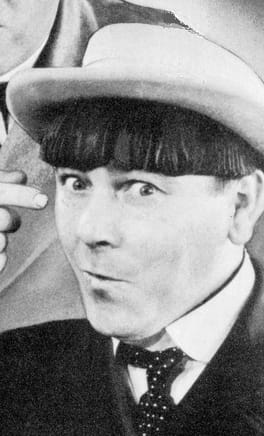
Photo: Columbia Pictures/Pillsbury / Public domain (source: Wikimedia Commons)
Moe Howard was credited as a stage actor, television actor and film actor. Moe Howard was born on June 19, 1897 in Bensonhurst, New York, United States. Death is recorded on May 4, 1975, at the age of 77. Education on record includes Erasmus Hall High School.
My Take
Moe Howard is one of those comedians whose genius hides behind apparent chaos. As the bowl-cut leader and straight man of The Three Stooges, he was the organizing intelligence of an act that survived vaudeville, film and television across four decades. People badly underrate how much cold precision goes into making slapstick land that consistently. The eye-pokes and head-slaps look anarchic, but the timing is almost mathematical, and someone had to be the steady hand steering it all. I have a deep affection for comedy this physical and this disciplined, and Moe sits very near the foundation of the whole tradition.
This take was written by generative AI, one per person, from publicly reported facts (editorial policy). It is a reading of the record, not reporting.
1. Profile
- Name (English)
- Moe Howard
- Name (Japanese)
- モー・ハワード
- Reading
- もー・はわーど
- Born
- June 19, 1897 – May 4, 1975
- Origin
- Bensonhurst, New York, United States
- Occupation
- stage actor / television actor / film actor / screenwriter / voice actor
- Zodiac / Chinese zodiac
- Gemini / Rooster
2. Background
- High school
- Erasmus Hall High School
3. Links
- Wikipedia (English)https://en.wikipedia.org/wiki/Moe%20Howard
- Wikipedia (Japanese)https://ja.wikipedia.org/wiki/%E3%83%A2%E3%83%BC%E3%83%BB%E3%83%8F%E3%83%AF%E3%83%BC%E3%83%89
- Wikidatahttps://www.wikidata.org/wiki/Q1281212
4. About this entry
Tags
- Last updated
Facts are limited to publicly available information up to 2024; non-public or unconfirmed items are omitted. English text is machine-assisted (facts translated by Sonnet, "My Take" written by Opus 4.8). The Japanese page is the source of record.
Frequently asked questions
When was Moe Howard born?
Born June 19, 1897.
When did Moe Howard die?
Died May 4, 1975, aged 77.
Where was Moe Howard from?
Moe Howard was from Bensonhurst, New York, United States.
What did Moe Howard do?
Moe Howard worked as stage actor, television actor, film actor, screenwriter, voice actor.
Stage actor — see all → · Television actor — see all → · More people from the United States →