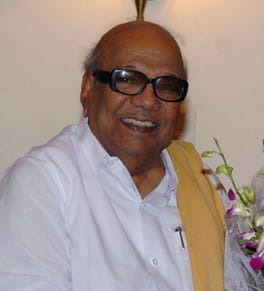
Photo: Prime Minister's Office / GODL-India (source: Wikimedia Commons)
Muthuvel Karunanidhi was listed as a politician, screenwriter and journalist. Muthuvel Karunanidhi was born in Thirukkuvalai, Tamil Nadu, India on June 3, 1924. Death is recorded on August 7, 2018, at the age of 94.
My Take
M. Karunanidhi operated on a scale that genuinely awes me. Five terms as Chief Minister of Tamil Nadu between 1969 and 2011, the longest in the state's history, alongside careers as screenwriter, journalist, author and film producer. Known as Kalaignar, the artist, he was a central force in the Dravidian movement who moved the masses with words as much as with policy. What I find remarkable is how his gift for storytelling and his gift for leadership sprang from the same root. Active into his nineties, he lived out the rare truth that language itself can govern a people.
This take was written by generative AI, one per person, from publicly reported facts (editorial policy). It is a reading of the record, not reporting.
1. Profile
- Name (English)
- Muthuvel Karunanidhi
- Name (Japanese)
- M・カルナーニディ
- Reading
- M・かるなーにでぃ
- Born
- June 3, 1924 – August 7, 2018
- Origin
- Thirukkuvalai, Tamil Nadu, India
- Occupation
- politician / screenwriter / journalist / writer / film producer
- Zodiac / Chinese zodiac
- Gemini / Rat
2. Links
- Official sitehttps://kalaignarkarunanidhi.com
- Wikipedia (English)https://en.wikipedia.org/wiki/M.%20Karunanidhi
- Wikipedia (Japanese)https://ja.wikipedia.org/wiki/M%E3%83%BB%E3%82%AB%E3%83%AB%E3%83%8A%E3%83%BC%E3%83%8B%E3%83%87%E3%82%A3
- Wikidatahttps://www.wikidata.org/wiki/Q470875
3. About this entry
Tags
- Last updated
Facts are limited to publicly available information up to 2024; non-public or unconfirmed items are omitted. English text is machine-assisted (facts translated by Sonnet, "My Take" written by Opus 4.8). The Japanese page is the source of record.
Frequently asked questions
When was Muthuvel Karunanidhi born?
Born June 3, 1924.
When did Muthuvel Karunanidhi die?
Died August 7, 2018, aged 94.
Where was Muthuvel Karunanidhi from?
Muthuvel Karunanidhi was from Thirukkuvalai, Tamil Nadu, India.
What did Muthuvel Karunanidhi do?
Muthuvel Karunanidhi worked as politician, screenwriter, journalist, writer, film producer.
Politician — see all → · Screenwriter — see all → · More people from India →