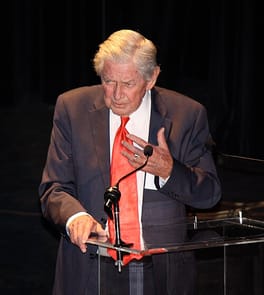
Photo: bekahjan / CC BY 2.0 (source: Wikimedia Commons)
Public records list Ralph Waite as a director, comedian and film actor. Ralph Waite was born on June 22, 1928 in White Plains, New York, United States. Death is recorded on February 13, 2014, at the age of 85. Education on record includes White Plains High School and Bucknell University.
My Take
Ralph Waite was one of those rare actors who could make you feel the weight of a whole family's love just by sitting down at a dinner table. As John Walton Sr. on The Waltons through most of the 1970s, he wasn't playing a hero in any flashy sense — he was playing a decent man trying to hold his family together during hard times, and he did it with such quiet conviction that you genuinely believed every word. What I find fascinating is that before acting he'd worked as a social worker and studied theology, and that moral seriousness shows in every performance. He brought the same steady warmth to his later work as Jackson Gibbs on NCIS, proving the "good father" archetype never gets old when someone plays it this honestly. A truly underrated anchor of American television.
This take was written by generative AI, one per person, from publicly reported facts (editorial policy). It is a reading of the record, not reporting.
1. Profile
- Name (English)
- Ralph Waite
- Name (Japanese)
- ラルフ・ウェイト
- Reading
- らるふ・うぇいと
- Born
- June 22, 1928 – February 13, 2014
- Origin
- White Plains, New York, United States
- Occupation
- director / comedian / film actor / voice actor / screenwriter
- Zodiac / Chinese zodiac
- Cancer / Dragon
2. Background
- High school
- White Plains High School
- University
- Bucknell University
3. Links
- Wikipedia (English)https://en.wikipedia.org/wiki/Ralph%20Waite
- Wikipedia (Japanese)https://ja.wikipedia.org/wiki/%E3%83%A9%E3%83%AB%E3%83%95%E3%83%BB%E3%82%A6%E3%82%A7%E3%82%A4%E3%83%88
- Wikidatahttps://www.wikidata.org/wiki/Q712450
4. About this entry
Tags
- Last updated
Only publicly available facts are listed; non-public or unconfirmed items are omitted. Base data was compiled from Wikidata from June 2026 onward; ages are recalculated daily and deaths are checked against Wikidata on an ongoing basis. English text is machine-assisted (facts translated by Sonnet, "My Take" written by Opus 4.8). The Japanese page is the source of record.
Frequently asked questions
When was Ralph Waite born?
Ralph Waite was born on June 22, 1928.
When did Ralph Waite die?
Ralph Waite died on February 13, 2014, aged 85.
Where was Ralph Waite from?
Ralph Waite was from White Plains, New York, United States.
What did Ralph Waite do?
Ralph Waite worked as director, comedian, film actor, voice actor, screenwriter.
Where did Ralph Waite study?
Ralph Waite attended Bucknell University.
Director — see all → · Comedian — see all → · More people from the United States → · More people born on June 22 →