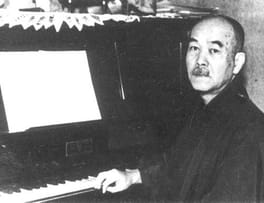
Photo: Unknown author / Public domain (source: Wikimedia Commons)
Born on June 28, 1868, Tokichi Setoguchi was from Kagoshima Prefecture, Japan. Tokichi Setoguchi was credited as a conductor, clarinetist and composer. Death is recorded on November 8, 1941, at the age of 73.
My Take
Tokichi Setoguchi is one of those figures who quietly did something extraordinary — he was born in Kagoshima in 1868, the very year the Meiji Restoration kicked off, and spent his entire life helping Japan absorb and shape Western music from the ground up. A clarinetist who could also conduct, compose, and teach, he wore every hat the nascent Japanese classical music scene needed. There's something genuinely moving about a man from Satsuma, a domain famous for its fierce, insular warrior culture, devoting himself to European musical forms at a time when Japan was still figuring out what "modern" even meant. He didn't live to see the postwar explosion of Japanese classical music, passing in 1941, but the infrastructure he and his peers built made that boom possible. A quiet pioneer worth knowing.
This take was written by generative AI, one per person, from publicly reported facts (editorial policy). It is a reading of the record, not reporting.
1. Profile
- Name (English)
- Tokichi Setoguchi
- Name (Japanese)
- 瀬戸口藤吉
- Reading
- せとぐち とうきち
- Born
- June 28, 1868 – November 8, 1941
- Origin
- Kagoshima Prefecture, Japan
- Occupation
- conductor / clarinetist / composer / musicologist / music educator
- Zodiac / Chinese zodiac
- Cancer / Dragon
2. Links
- Wikipedia (English)https://en.wikipedia.org/wiki/Tokichi%20Setoguchi
- Wikipedia (Japanese)https://ja.wikipedia.org/wiki/%E7%80%AC%E6%88%B8%E5%8F%A3%E8%97%A4%E5%90%89
- Wikidatahttps://www.wikidata.org/wiki/Q856996
3. About this entry
Tags
- Last updated
Only publicly available facts are listed; non-public or unconfirmed items are omitted. Base data was compiled from Wikidata from June 2026 onward; ages are recalculated daily and deaths are checked against Wikidata on an ongoing basis. English text is machine-assisted (facts translated by Sonnet, "My Take" written by Opus 4.8). The Japanese page is the source of record.
Frequently asked questions
When was Tokichi Setoguchi born?
Tokichi Setoguchi was born on June 28, 1868.
When did Tokichi Setoguchi die?
Tokichi Setoguchi died on November 8, 1941, aged 73.
Where was Tokichi Setoguchi from?
Tokichi Setoguchi was from Kagoshima Prefecture, Japan.
What did Tokichi Setoguchi do?
Tokichi Setoguchi worked as conductor, clarinetist, composer, musicologist, music educator.
Conductor — see all → · Clarinetist — see all → · More people from Japan → · More people born on June 28 →