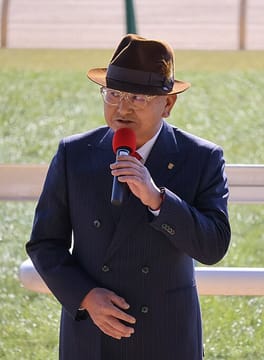
Photo: 馬三浪 / CC0 (source: Wikimedia Commons)
My Take
I'll be honest, I went in expecting another quiet, stone-faced racing trainer, and Yoshito Yahagi completely flipped that on me. The guy is a talker, a laugher, the kind of personality who actually lights up an interview instead of grumbling through it, and I love that horse racing has room for someone this expressive. Born in Tokyo back in 1961 and well past sixty, he still carries this restless, big-dreaming energy, the sort of trainer who genuinely believes he can take Japanese horses out into the world and then keeps proving it on the biggest international stages. There's a real swagger to that ambition, but it's paired with warmth, and that combo is rare. He's got the hard-earned edge of someone who's survived decades in a brutal game, yet he's still grinning. I just find myself rooting for him.
This take was written by generative AI, one per person, from publicly reported facts (editorial policy). It is a reading of the record, not reporting.
Overview
Yoshito Yahagi is a Japanese horse racing trainer born on March 20, 1961, in Tokyo. He has built a reputation as one of Japan's prominent trainers, known for his outspoken personality and ambition to compete on the international stage. His stable has produced runners in major races both domestically and abroad. He graduated from Kaisei High School, learned horse training in Australia, received his trainer's license in 2004 and opened his stable in 2005, and is known in foreign media as "the man in the hat."
1. Profile
- Name (English)
- Yoshito Yahagi
- Name (Japanese)
- 矢作芳人
- Reading
- やはぎ よしと
- Born
- March 20, 1961 (age 65)
- Origin
- Tokyo, Japan
- Occupation
- Horse Racing Trainer
- Zodiac / Chinese zodiac
- Pisces / Ox
2. Links
- Wikipedia (Japanese)https://ja.wikipedia.org/wiki/%E7%9F%A2%E4%BD%9C%E8%8A%B3%E4%BA%BA
- Wikidatahttps://www.wikidata.org/wiki/Q11583924
3. About this entry
Tags
- Last updated
Only publicly available facts are listed; non-public or unconfirmed items are omitted. Base data was compiled from Wikidata from June 2026 onward; ages are recalculated daily and deaths are checked against Wikidata on an ongoing basis. English text is machine-assisted (facts translated by Sonnet, "My Take" written by Opus 4.8). The Japanese page is the source of record.
Frequently asked questions
When was Yoshito Yahagi born?
Yoshito Yahagi was born on March 20, 1961 and is 65 years old.
Where is Yoshito Yahagi from?
Yoshito Yahagi is from Tokyo, Japan.
What does Yoshito Yahagi do?
Yoshito Yahagi works as Horse Racing Trainer.