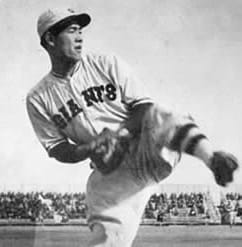
Photo: Unknown author / Public domain (source: Wikimedia Commons)
Eiji Sawamura was a professional baseball player. Eiji Sawamura was born on February 1, 1917 in Ise, Mie Prefecture, Japan. Death is recorded on December 2, 1944, at the age of 27. Awards on record include Japanese Baseball Hall of Fame. The listed height was 174 cm.
My Take
Sawamura died on December 2, 1944, at twenty-seven, and everything else about him has to be read through that fact. Born in Ise, Mie Prefecture, in 1917, he pitched for the Yomiuri Giants, threw three no-hitters - something almost nobody in Japanese baseball has matched - had his number retired, and was enshrined in the Hall of Fame. Japan's annual award for its finest pitcher still carries his name. What stays with me is the arithmetic of what was taken: a career interrupted and then ended by the war, at an age when most pitchers are only beginning to understand their craft. The legend is real, and so is the loss.
This take was written by generative AI, one per person, from publicly reported facts (editorial policy). It is a reading of the record, not reporting.
1. Profile
- Name (English)
- Eiji Sawamura
- Name (Japanese)
- 沢村栄治
- Reading
- さわむら えいじ
- Born
- February 1, 1917 – December 2, 1944
- Origin
- Ise, Mie Prefecture, Japan
- Height
- 174 cm
- Occupation
- baseball player / professional baseball player
- Zodiac / Chinese zodiac
- Aquarius / Snake
2. Background
Awards & achievements
- Japanese Baseball Hall of Fame
3. Links
- Wikipedia (English)https://en.wikipedia.org/wiki/Eiji%20Sawamura
- Wikipedia (Japanese)https://ja.wikipedia.org/wiki/%E6%B2%A2%E6%9D%91%E6%A0%84%E6%B2%BB
- Wikidatahttps://www.wikidata.org/wiki/Q700579
4. About this entry
Tags
- Last updated
Facts are limited to publicly available information up to 2024; non-public or unconfirmed items are omitted. English text is machine-assisted (facts translated by Sonnet, "My Take" written by Opus 4.8). The Japanese page is the source of record.
Frequently asked questions
When was Eiji Sawamura born?
Born February 1, 1917.
When did Eiji Sawamura die?
Died December 2, 1944, aged 27.
Where was Eiji Sawamura from?
Eiji Sawamura was from Ise, Mie Prefecture, Japan.
What did Eiji Sawamura do?
Eiji Sawamura worked as baseball player, professional baseball player.
How tall was Eiji Sawamura?
Eiji Sawamura was 174 cm.
Baseball player — see all → · Professional baseball player — see all → · More people from Japan →