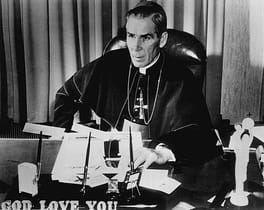
Photo: ABC Radio / Public domain (source: Wikimedia Commons)
Fulton J. Sheen, born on May 8, 1895 in El Paso, Illinois, United States, was a television presenter, radio personality and essayist. Death is recorded on December 9, 1979, at the age of 84. Fulton J. Sheen studied at Peoria Notre Dame High School and The Catholic University of America. Awards on record include Primetime Emmy Award, James Cardinal Gibbons Medal and Order of Lincoln (1977). Credited works include Life Is Worth Living.
My Take
What fascinates me about Fulton J. Sheen is that a Catholic bishop walked onto the new medium of television and walked off with a Primetime Emmy. Born in El Paso, Illinois, in 1895, a precocious theologian, he reached millions through radio and then the screen. His program Life Is Worth Living survives as a title precisely because the man behind it understood that doctrine without delivery reaches no one. He was, in the truest sense, a broadcaster, holding a mass audience in an era of stiff, formal preaching. I rate him as both a man of faith and a first-rate communicator whose showmanship still instructs.
This take was written by generative AI, one per person, from publicly reported facts (editorial policy). It is a reading of the record, not reporting.
1. Profile
- Name (English)
- Fulton J. Sheen
- Name (Japanese)
- フルトン・J・シーン
- Reading
- ふるとん・J・しーん
- Born
- May 8, 1895 – December 9, 1979
- Origin
- El Paso, Illinois, United States
- Occupation
- television presenter / radio personality / essayist / writer / Catholic priest
- Zodiac / Chinese zodiac
- Taurus / Goat
2. Background
- High school
- Peoria Notre Dame High School
- University
- The Catholic University of America
Awards & achievements
- Primetime Emmy Award
- James Cardinal Gibbons Medal
- 1977 Order of Lincoln
3. Works & records
Filmography / notable works
| Category | Title |
|---|---|
| Notable work | Life Is Worth Living |
4. Links
- Official sitehttps://www.bishopsheen.com
- Wikipedia (English)https://en.wikipedia.org/wiki/Fulton%20J.%20Sheen
- Wikipedia (Japanese)https://ja.wikipedia.org/wiki/%E3%83%95%E3%83%AB%E3%83%88%E3%83%B3%E3%83%BBJ%E3%83%BB%E3%82%B7%E3%83%BC%E3%83%B3
- Wikidatahttps://www.wikidata.org/wiki/Q954398
5. About this entry
Tags
- Last updated
Facts are limited to publicly available information up to 2024; non-public or unconfirmed items are omitted. English text is machine-assisted (facts translated by Sonnet, "My Take" written by Opus 4.8). The Japanese page is the source of record.
Frequently asked questions
When was Fulton J. Sheen born?
Born May 8, 1895.
When did Fulton J. Sheen die?
Died December 9, 1979, aged 84.
Where was Fulton J. Sheen from?
Fulton J. Sheen was from El Paso, Illinois, United States.
What did Fulton J. Sheen do?
Fulton J. Sheen worked as television presenter, radio personality, essayist, writer, Catholic priest.
What was Fulton J. Sheen known for?
Notable works include Life Is Worth Living.
Television presenter — see all → · Radio personality — see all → · More people from the United States →