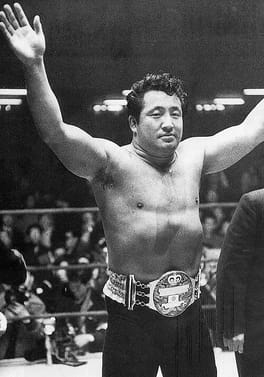
Photo: Unknown photographer / Public domain (source: Wikimedia Commons)
Rikidōzan, born on November 14, 1924 in Hongwon County, South Hamgyong Province, North Korea, was a rikishi, actor and professional wrestler. Death is recorded on December 15, 1963, at the age of 39. Recorded honors include WWE Hall of Fame and Wrestling Observer Newsletter Hall of Fame. Rikidōzan was listed at 175 cm.
My Take
Rikidōzan is one of those figures whose cultural weight dwarfs his statistics. A sumo wrestler turned pro wrestler, he became the symbol of postwar Japanese resilience, his televised matches giving a recovering nation someone to rally behind. The Korean-born background he kept private adds a poignant layer to his myth. What strikes me most is how he essentially invented the television sports hero in Japan, dead far too young at 39 yet permanently enshrined in multiple halls of fame. I respect him less as an athlete than as a catalyst who gave millions a reason to feel proud again.
This take was written by generative AI, one per person, from publicly reported facts (editorial policy). It is a reading of the record, not reporting.
1. Profile
- Name (English)
- Rikidōzan
- Name (Japanese)
- 力道山
- Reading
- りきどうざん
- Real name
- 百田光浩
- Born
- November 14, 1924 – December 15, 1963
- Origin
- Hongwon County, South Hamgyong Province, North Korea
- Height
- 175 cm
- Occupation
- rikishi / actor / professional wrestler / catch trainer / amateur wrestler
- Zodiac / Chinese zodiac
- Scorpio / Rat
2. Background
Awards & achievements
- WWE Hall of Fame
- Wrestling Observer Newsletter Hall of Fame
3. Links
- Wikipedia (English)https://en.wikipedia.org/wiki/Rikid%C5%8Dzan
- Wikipedia (Japanese)https://ja.wikipedia.org/wiki/%E5%8A%9B%E9%81%93%E5%B1%B1
- Wikidatahttps://www.wikidata.org/wiki/Q484173
4. About this entry
Tags
- Last updated
Facts are limited to publicly available information up to 2024; non-public or unconfirmed items are omitted. English text is machine-assisted (facts translated by Sonnet, "My Take" written by Opus 4.8). The Japanese page is the source of record.
Frequently asked questions
When was Rikidōzan born?
Rikidōzan was born on November 14, 1924.
When did Rikidōzan die?
Rikidōzan died on December 15, 1963, aged 39.
Where was Rikidōzan from?
Rikidōzan was from Hongwon County, South Hamgyong Province, North Korea.
What did Rikidōzan do?
Rikidōzan worked as rikishi, actor, professional wrestler, catch trainer, amateur wrestler.
How tall was Rikidōzan?
Rikidōzan was 175 cm tall.
Rikishi — see all → · Actor — see all → · More people from North Korea → · More people born on November 14 →