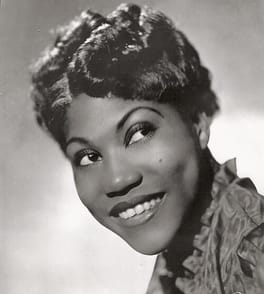
Photo: James J. Kriegsmann / Public domain (source: Wikimedia Commons)
Sister Rosetta Tharpe, born on March 20, 1915 in Cotton Plant, Arkansas, United States, was a musician, jazz guitarist and gospel singer. Sister Rosetta Tharpe died on October 9, 1973, aged 58. Listed accolades include Rock and Roll Hall of Fame (2018), Arkansas Black Hall of Fame (2012), Arkansas Entertainers Hall of Fame (2013) and 1 more.
My Take
I genuinely think Sister Rosetta Tharpe doesn't get nearly enough credit for what she did — this woman was essentially inventing rock and roll in the 1930s and 40s while the genre hadn't even been named yet. She'd grown up in the Church of God in Christ, and instead of keeping gospel music confined to the pews, she dragged it onto nightclub stages and into secular venues, scandalizing religious communities and thrilling everyone else. That electric guitar playing was ferocious — aggressive, distorted, deeply soulful — and it directly inspired legends like Chuck Berry, Little Richard, and Johnny Cash. The Rock and Roll Hall of Fame finally inducted her in 2018, decades after her 1973 passing, which felt both long overdue and bittersweet. She was a Black queer woman breaking every rule imaginable in mid-century America, and she did it with unshakeable confidence. A true original.
This take was written by generative AI, one per person, from publicly reported facts (editorial policy). It is a reading of the record, not reporting.
1. Profile
- Name (English)
- Sister Rosetta Tharpe
- Name (Japanese)
- シスター・ロゼッタ・サープ
- Reading
- しすたー・ろぜった・さーぷ
- Born
- March 20, 1915 – October 9, 1973
- Origin
- Cotton Plant, Arkansas, United States
- Occupation
- musician / singer / guitarist / jazz guitarist / gospel singer
- Zodiac / Chinese zodiac
- Pisces / Rabbit
2. Background
Awards & achievements
- 2018 Rock and Roll Hall of Fame
- 2012 Arkansas Black Hall of Fame
- 2013 Arkansas Entertainers Hall of Fame
- 2022 Arkansas Women's Hall of Fame
3. Links
4. About this entry
Tags
- Last updated
Only publicly available facts are listed; non-public or unconfirmed items are omitted. Base data was compiled from Wikidata from June 2026 onward; ages are recalculated daily and deaths are checked against Wikidata on an ongoing basis. English text is machine-assisted (facts translated by Sonnet, "My Take" written by Opus 4.8). The Japanese page is the source of record.
Frequently asked questions
When was Sister Rosetta Tharpe born?
Sister Rosetta Tharpe was born on March 20, 1915.
When did Sister Rosetta Tharpe die?
Sister Rosetta Tharpe died on October 9, 1973, aged 58.
Where was Sister Rosetta Tharpe from?
Sister Rosetta Tharpe was from Cotton Plant, Arkansas, United States.
What did Sister Rosetta Tharpe do?
Sister Rosetta Tharpe worked as musician, singer, guitarist, jazz guitarist, gospel singer.
Musician — see all → · Singer — see all → · More people from the United States → · More people born on March 20 →