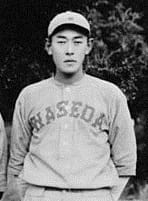
Photo: Bain News Service / Public domain (source: Wikimedia Commons)
My Take
Jiro Kuji is one of those figures who makes you stop and think about how much one person can pack into a single lifetime — and a short one at that. Born in Aomori in 1898, he died at just forty years old in 1939, before the war he probably saw coming had even fully ignited. What gets me is the combination: a baseball player and a politician, both, with a Waseda education tying it together. That's not someone drifting through life — that's someone who decided early that one path wasn't enough. I find myself wondering what he was like behind the plate for Waseda and Hakodate, what he argued for on the Hakodate city council, whether the grit you imagine in a prewar Aomori man showed up in both places equally. He was remembered as the "god of catchers," and he died after taking a throw to the head mid-game, which almost makes it more haunting. A life that full, gone before fifty, and now mostly quiet in the archives.
This take was written by generative AI, one per person, from publicly reported facts (editorial policy). It is a reading of the record, not reporting.
Overview
Jirō Kuji (1898–1939) was a Japanese baseball player and politician born in Aomori Prefecture. A catcher hailed as the "god of catchers" at Waseda University, he starred for the Hakodate club team Hakodate Taiyo Club, was elected to the Hakodate city council without campaigning, and died on August 21, 1939, at the age of 40 after being struck in the head by a throw during a game.
1. Profile
- Name (English)
- Jirō Kuji
- Name (Japanese)
- 久慈次郎
- Reading
- くじ じろう
- Born
- October 1, 1898 – August 21, 1939
- Origin
- Aomori Prefecture, Japan
- Occupation
- Baseball player / Politician
- Zodiac / Chinese zodiac
- Libra / Dog
2. Background
- University
- Waseda University
3. Links
- Wikipedia (Japanese)https://ja.wikipedia.org/wiki/%E4%B9%85%E6%85%88%E6%AC%A1%E9%83%8E
- Wikidatahttps://www.wikidata.org/wiki/Q11369335
4. About this entry
Tags
- Last updated
Only publicly available facts are listed; non-public or unconfirmed items are omitted. Base data was compiled from Wikidata from June 2026 onward; ages are recalculated daily and deaths are checked against Wikidata on an ongoing basis. English text is machine-assisted (facts translated by Sonnet, "My Take" written by Opus 4.8). The Japanese page is the source of record.
Frequently asked questions
When was Jirō Kuji born?
Jirō Kuji was born on October 1, 1898.
When did Jirō Kuji die?
Jirō Kuji died on August 21, 1939, aged 40.
Where was Jirō Kuji from?
Jirō Kuji was from Aomori Prefecture, Japan.
What did Jirō Kuji do?
Jirō Kuji worked as Baseball player, Politician.
Where did Jirō Kuji study?
Jirō Kuji attended Waseda University.
Baseball player — see all → · Politician — see all → · More people from Japan → · More people born on October 1 →