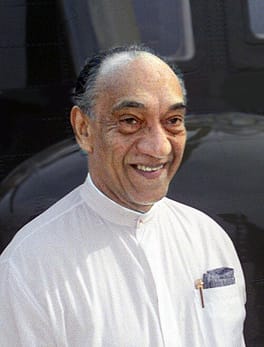
Photo: Department of Defense. American Forces Information Service. Defense Visual Information Center. / Public domain (source: Wikimedia Commons)
Public records list Junius Richard Jayewardene as a cricketer, diplomat and politician. Born on September 17, 1906, Junius Richard Jayewardene was from Colombo, Colombo District, Sri Lanka. Death is recorded on November 1, 1996, at the age of 90. Schooling on record includes Sri Lanka Law College.
My Take
I'll be honest — J. R. Jayewardene is one of those figures who quietly shaped a whole nation's trajectory without ever becoming a household name outside South Asia, and that's a genuine shame. Born in Colombo in 1906, this guy was a lawyer, diplomat, politician, and even a cricketer, which tells you something about the sheer range of the man. He steered Sri Lanka through one of its most turbulent periods, serving as prime minister and then becoming the country's second president in 1978 after engineering a shift to an executive presidency that fundamentally rewired the constitution. His tenure wasn't without controversy — the ethnic tensions that escalated into civil war on his watch remain a painful chapter — but the economic liberalization he pushed through was genuinely bold for its era. Lived to 90, witnessed his country's entire modern transformation. A complicated, consequential life.
This take was written by generative AI, one per person, from publicly reported facts (editorial policy). It is a reading of the record, not reporting.
1. Profile
- Name (English)
- Junius Richard Jayewardene
- Name (Japanese)
- ジュニウス・リチャード・ジャヤワルダナ
- Reading
- じゅにうす・りちゃーど・じゃやわるだな
- Born
- September 17, 1906 – November 1, 1996
- Origin
- Colombo, Colombo District, Sri Lanka
- Occupation
- cricketer / diplomat / politician / lawyer
- Zodiac / Chinese zodiac
- Virgo / Horse
2. Background
- University
- Sri Lanka Law College
3. Links
- Wikipedia (English)https://en.wikipedia.org/wiki/J.%20R.%20Jayewardene
- Wikipedia (Japanese)https://ja.wikipedia.org/wiki/%E3%82%B8%E3%83%A5%E3%83%8B%E3%82%A6%E3%82%B9%E3%83%BB%E3%83%AA%E3%83%81%E3%83%A3%E3%83%BC%E3%83%89%E3%83%BB%E3%82%B8%E3%83%A3%E3%83%A4%E3%83%AF%E3%83%AB%E3%83%80%E3%83%8A
- Wikidatahttps://www.wikidata.org/wiki/Q469661
4. About this entry
Tags
- Last updated
Facts are limited to publicly available information up to 2024; non-public or unconfirmed items are omitted. English text is machine-assisted (facts translated by Sonnet, "My Take" written by Opus 4.8). The Japanese page is the source of record.
Frequently asked questions
When was Junius Richard Jayewardene born?
Born September 17, 1906.
When did Junius Richard Jayewardene die?
Died November 1, 1996, aged 90.
Where was Junius Richard Jayewardene from?
Junius Richard Jayewardene was from Colombo, Colombo District, Sri Lanka.
What did Junius Richard Jayewardene do?
Junius Richard Jayewardene worked as cricketer, diplomat, politician, lawyer.
Cricketer — see all → · Diplomat — see all → · More people from Sri Lanka →